A teacher told my six-year-old daughter with Down syndrome that not even makeup could make her beautiful. She had no idea that the little girl’s mother was about to teach her a lesson she would never forget…
My daughter had been looking forward to her first school celebration for days. But barely an hour after I dropped her off at school, the principal called me with some unexpected news.
“Mrs. Parker, Victoria has been crying for twenty minutes. She keeps asking us to call you. Could you come to the school?”
My heart sank.
“What happened? Is she hurt?”
“She’s physically fine, but she’s very upset.”
I grabbed my keys and rushed out the door.
My six-year-old daughter, Victoria, has Down syndrome. Enrolling her in first grade was one of the hardest decisions I had ever made.
I was constantly worried. Would the other children accept her? Would they make fun of her? Would she notice if someone treated her differently? And most importantly, would she tell me if someone hurt her feelings?
But more than anything, Victoria wanted to go to school.
During the first two weeks, she was happier than I had ever seen her. Every afternoon, she would run into my arms, excitedly tell me about her new friends, and show me her drawings.
For the first time, she felt like she belonged somewhere.
Then came the day of her first school celebration.
She was especially excited that morning. I kissed her forehead, straightened her little dress, and walked her to school.
Everything seemed perfectly fine.
Until that phone call.
When I arrived, I found Victoria in the hallway. Children were laughing, playing, and showing off their beautifully painted faces. A young teacher was painting colorful butterflies on another little girl’s face.
The moment Victoria saw me, she ran into my arms.
“Mommy, I want to go home!”
I gently hugged her.
“Sweetheart, what happened?”
She pointed toward the teacher.
“She said makeup is for pretty girls. And she won’t paint my face because I’m ugly.”
For a moment, I couldn’t find the words.
I knelt down and looked into my daughter’s tear-filled eyes.
“Mommy, am I really ugly? Will I never be pretty? Please don’t lie to me!”
I felt my heart breaking.
I wiped away her tears and kissed her forehead.
“Victoria, you are beautiful, sweetheart! Never let anyone make you believe otherwise.”
“But Mommy, she’s a teacher! Teachers aren’t supposed to lie.”
I looked toward the woman. She was still smiling, happily painting another child’s face, completely unaware of the damage her words had caused my little girl.
That was when an idea came to me.
“Sweetheart, would you go back to the principal’s office and wait for me there? Mommy needs another five minutes.”
“Are we going home?”
“We’re going to the movies, darling! And afterward, we’ll get your favorite ice cream. I promise.”
Victoria hugged me tightly before running back down the hallway.
I watched until she disappeared through the principal’s office door.
Then I turned toward the teacher.
We had never met before. She didn’t know I was Victoria’s mother.
And I decided not to tell her just yet.
Because no child should ever feel less beautiful, less valuable, or less deserving of kindness simply because they are different from everyone else.
I walked straight toward her table.
She had just finished painting another little girl’s face when I stopped beside her.
“Excuse me,” I said calmly. “I was hoping you could help me with something.”
She looked up at me with a smile.
What happened next made that smile turn into an expression of complete disbelief…
To be continued — the full story is in the first comment. 👇
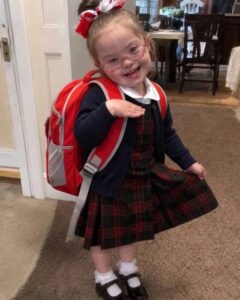
I confronted my six-year-old daughter’s teacher after she told my little girl with Down syndrome that makeup couldn’t make her beautiful.
Victoria had been looking forward to the school celebration, but when I arrived, I found her crying outside the principal’s office.
“Mommy, she said girls like me aren’t pretty,” she whispered.
My heart broke.
I confronted the teacher about what had happened, and she tried to justify her cruel words. But what happened next surprised everyone.
I offered to take over the face painting. Soon, a line of children formed, waiting for butterflies, tigers, and dinosaurs.
Then Victoria said something that broke my heart even more: she had been hiding the things she loved because she wanted everyone to accept her.
When she finally asked me to paint a huge green dinosaur on her face, I realized just how badly I had misunderstood what she really needed.
She didn’t need to be like everyone else. She needed to feel free to be herself.
And that day, I learned a lesson every parent should remember:
Our children don’t have to fit in to be beautiful. They need to know that they are loved exactly as they are.