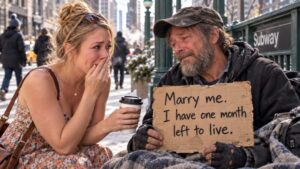
A homeless man was holding up a sign that read: “Marry me. I only have one month left to live.” — Out of pity, I married him… But three weeks after his death, a letter arrived that made me question everything I thought I knew about the man I had just buried. ??
For nearly two years, Larry had been nothing more to me than the homeless man who stood outside my subway station.
Every morning, on my way to work, I would buy him a black coffee.
He never begged.
He never bothered anyone.
He would simply smile, thank me, and ask if I thought it was going to rain.
Over time, those five-minute conversations had become part of my daily routine.
But one freezing Tuesday morning, everything changed.
Larry wasn’t holding his usual cardboard cup.
He was holding a piece of cardboard.
And on it, seven trembling black words were written—seven words that left me completely frozen:
“Marry me. I only have one month left.”
I honestly thought it was a joke.
Then I looked at his face.
He looked thinner than ever.
His skin was pale, his hands were trembling, and there was something frighteningly calm in his eyes.
I knelt down beside him.
“Larry… what happened?”
He stared at the sidewalk.
“At the clinic, they said my liver was failing.”
My chest tightened.
“How much time?”
He swallowed.
“Maybe a month.”
Then he looked at me and said something I will never forget.
“I don’t want to die like I was nobody, Sarah.”
I didn’t understand.
Larry explained that he had no family, no one to contact in case of an emergency, and no one who could take care of his remains when he died.
“I just want someone to be able to say, ‘He was mine,’” he whispered. “Even if it’s only on paper.”
? I should have walked away.
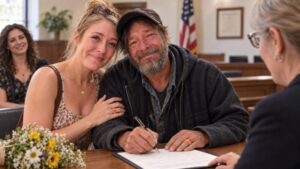
Instead, two days later, I was standing beside him at the courthouse.
No flowers.
No rings.
No wedding dress.
Just two signatures and the relieved smile of a dying man.
Three weeks later, Larry died peacefully in a hospice.
I arranged his funeral myself.
I thought our strange little story ended there.
I was wrong.
Yesterday, I opened my mailbox and found a large envelope addressed to me, in Larry’s handwriting.
It had been mailed the day before he died.
I took it up to my apartment, sat down at the kitchen table, and opened it, expecting nothing more than a final thank-you.
But from the very first sentence, my hands began to tremble.
“Sarah, before you read this, you need to understand that almost everything I told you about myself was a lie.”
I kept reading.
And by the time I reached the end of the first page, all the color had drained from my face. ?
Because Larry hadn’t asked me to marry him simply because he was afraid of dying alone…
He had chosen me long before I had even noticed his presence outside that subway station.
The rest is in the first comment ??‼️

The second page began with a name I hadn’t heard in almost twenty years.
Michael Bennett.
My father.
For a moment, I stopped breathing.
Larry’s handwriting continued just below.
“Your father was the reason I knew who you were.”
I stared at that sentence until the letters blurred before my eyes.
My father had died when I was seventeen.
He was a quiet man, a mechanic who worked too much, worried too much, and never seemed to have enough money. After his death, my mother and I went through some very difficult years.
What could Larry possibly have known about him?
I kept reading.
“Your father and I worked together before you were born. Not in an auto repair shop. That came later. We worked at the district courthouse.”
I almost laughed.
Larry?
The man who slept under an awning near the subway?
The man whose winter coat was held together with silver duct tape?
A courthouse employee?
In the letter, he told me to go there and ask for a woman named Margaret Ellis.
Two hours later, I was standing beneath the marble columns of the district courthouse, Larry’s letter carefully folded inside my purse.
Margaret turned out to be a petite woman in her seventies, with red-framed glasses and silver hair.
The moment I said Larry’s full name, her expression changed.
“Lawrence Hayes?”
I nodded.
Her hand flew to her mouth.
“Oh my God.”
“You knew him?”
Margaret slowly took off her glasses.
“I worked alongside him for twenty-six years.”
The room seemed to spin around me.
“What did he do?”
“He was in charge of marriage certificates.”
I stared at her.
Margaret smiled sadly.
“Larry probably signed more marriage certificates as a witness than anyone else who ever worked in this building.”
She led me to a records room and pulled out a huge old binder.
Page after page, it contained the names of strangers.
Different couples.
Different years.
But at the bottom of countless pages was always the same signature.
Lawrence Hayes — Witness.
My throat tightened.
Larry had spent decades standing beside people on one of the most important days of their lives.
And yet, he had never told me about it.
“Was he married?” I asked.
Margaret hesitated.
“No.”
“Never?”
“Never.”
She closed the binder.
“Larry always joked that he had witnessed hundreds of weddings, but he had always been on the wrong side of the desk.”
Something inside me broke.
Suddenly, I remembered our wedding at the courthouse.
Larry’s trembling hands.
The way he had looked at our marriage certificate.
That strange smile on his face when the clerk called me his wife.
I had assumed he was nervous because he was dying.
Now, I wasn’t so sure.
“But what does any of this have to do with my father?”
Margaret looked surprised.
“Michael never told you anything?”
“Told me what?”
She opened another filing cabinet.
After searching for a few minutes, she pulled out an old photograph.
Three men were standing in front of the courthouse.
One of them was Larry.
Younger.
Clean-shaven.
Wearing a suit.
And standing beside him was my father.
I put my hand over my mouth.
“No…”
“He and Larry were best friends,” Margaret said.
My knees suddenly gave way.
She explained that my father had worked as a security guard at the courthouse before becoming a mechanic.
Larry and Michael had lunch together almost every day.
When I was born, my father would bring photos of me to work.
Apparently, Larry had followed my childhood through those photos.
Then everything changed.
My father left the courthouse.
The years passed.
They lost touch.
When my father died, Larry didn’t find out until much too late.
By then, Larry’s own life had begun to fall apart as well.
His mother became ill.
Then the medical bills swallowed up all his savings.
After he retired, he lost his home.
His pride kept him from calling his former colleagues.
Eventually, he ended up outside the subway station.
Exactly where I walked past him every morning.
Margaret’s voice grew softer.
“When he saw you for the first time, he recognized you immediately.”
A chill ran through me.
“But I didn’t recognize him.”
“You were still a child the last time he had seen you.”
“So, for two years, he knew…”
“Exactly who you were.”
My eyes filled with tears.
The coffee.
The conversations about the weather.
His jokes about my shoes.
All those mornings when I thought two strangers were slowly becoming friends.
We had never been strangers.
At least, not to him.
I left the courthouse and sat down on the stone steps before opening the final pages of Larry’s letter.
“Your father made me promise something one day,” he wrote.
“He told me that if anything ever happened to him and I ever crossed paths with you, I was to make sure you were okay.”
Tears streamed down my face.
“I failed to keep that promise for years. When I finally found you, I was the one who needed help.”
I pressed the paper against my lips.
Then came the sentence I had been dreading.
“I didn’t ask you to marry me because I needed someone to take care of my remains.”
I already knew that part.
But the next sentence changed everything.
“I asked because I had spent my entire life watching other people choose each other, and I wanted to know, at least once, what it felt like to belong to someone.”
I closed my eyes.
Larry had manipulated me.
There was no denying it.
He had turned his loneliness into a practical emergency because he knew that practical emergencies were exactly the things I could never ignore.
He admitted that in his letter, too.
“You had the right to know the truth. I was afraid that if I simply asked you, ‘Would you be willing to give a lonely, dying man the feeling of belonging to someone?’ you would pity me and politely say no.”
Through my tears, I started laughing.
“Idiot.”
People sitting on the courthouse steps were looking at me.
I didn’t care.
The final paragraph was shorter.
“Sarah, don’t remember me as the homeless man you saved.”
“I was never your responsibility.”
“For three weeks, I was your husband. And for the first time in my life, I had an answer when someone asked me who my family was.”
I sat there crying until my hands grew cold.
Then I noticed something inside the envelope.
A photograph.
My father was standing in front of the courthouse, holding a very small child in his arms.
Me.
Larry was standing beside him.
On the back, my father had written:
“Larry — if she turns out to be as stubborn as her mother, good luck.”
I laughed so hard that a woman walking past me turned around.
Three days later, I went back to the subway station.
I bought two coffees.
Mine with cream.
Larry’s black.
His usual spot was empty.
I sat there anyway.
For nearly two years, I had always stayed for only five minutes.
There was always somewhere I had to go.
Something to do.
Something more important waiting for me.
That morning, I stayed until the coffee went cold.
And for the first time, I understood what Larry had really wanted from me.
Not to be saved.
Not money.
Not paperwork.
Just someone willing to sit beside him long enough that he no longer felt invisible.
I placed the untouched black coffee against the wall and whispered:
“You were never nobody, Larry.”
Then I looked at our marriage certificate one last time.
For twenty-six years, next to Larry’s name, there had been only one word:
Witness.
But during the final three weeks of his life, another word appeared next to his name.
Husband.
And suddenly, I understood why he had smiled when the clerk said that word out loud.
His entire life, he had watched other people become someone’s family or partner.
Before he died, he simply wanted to know what it felt like, too, to belong to someone.